
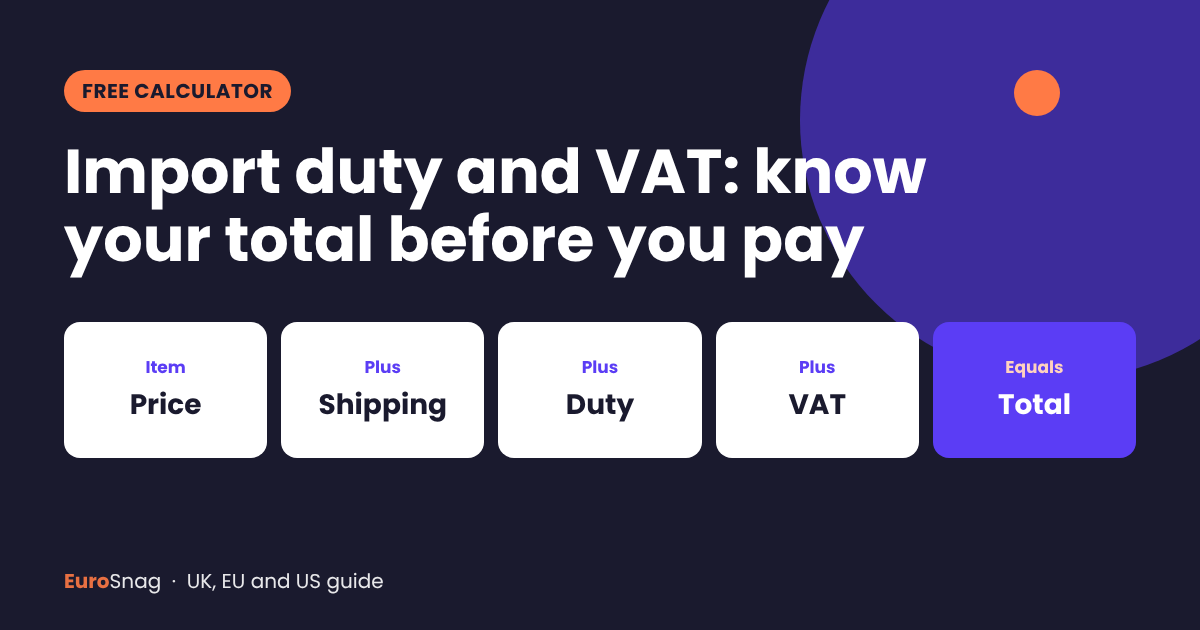
Quick answer: before you pay for an order shipped from another country, add up four things: the item price, shipping, any import duty, and VAT. Use the free import duty and VAT calculator below to see an estimated total, and read the short guide to learn which rules apply in the UK, the EU and the US.
Last updated: 25 November 2026. Rules change, so always check the official pages linked at the bottom.
Why does an order cost more than the price in the shop?
When goods cross a border, the country they enter can charge customs duty (a tax on certain goods, based on the product and where it was made) and VAT or import tax. Some shops include these in the price at checkout. Others leave them for the courier to collect when the parcel arrives. That second case is where shoppers get surprised.
Import duty and VAT at a glance (UK, EU, US)
| Destination | Duty on small parcels | VAT |
|---|---|---|
| UK (Great Britain) | No customs duty on most goods worth £135 or less. Duty can apply above £135. | Charged on goods from abroad. At £135 or less the seller usually includes it at checkout. Above £135 you pay it to the carrier. |
| EU | A flat €3 duty per item on small parcels worth up to €150 from 1 July 2026 (temporary measure). Normal rates apply above €150. | VAT applies to imported goods. It is added at checkout or by the courier. |
| US | The old $800 duty-free exemption (de minimis) is suspended, so duty can apply to low-value parcels too. | No national VAT. Some states charge sales tax at checkout. |
This table is a simple summary. The exact amount depends on the product, its origin and the courier. Details are below.
UK import duty and VAT
For goods sent to Great Britain from abroad, the UK government says VAT is charged on all goods except gifts worth £39 or less.
- Goods worth £135 or less: if you bought them yourself, the seller usually includes VAT in the price. Most goods in this band have no customs duty.
- Goods worth more than £135: you normally pay VAT and any customs duty to the carrier before delivery or when you collect the parcel. Duty depends on the type of goods and where they come from, and it is worked out on the price plus postage, packaging and insurance.
- Unpaid parcels: Royal Mail, Parcelforce or the courier will normally hold a parcel for about three weeks before returning it to the sender.
- Northern Ireland has separate rules for some goods, so check the official page if you live there.
EU customs duty and VAT
The EU has changed its rules for small parcels. From 1 July 2026, a flat customs duty of €3 per item applies to low-value parcels (up to €150 in total value), replacing the old €150 duty exemption. This is a temporary measure that is planned to run until 1 July 2028 and may be reviewed. VAT is a separate charge on imported goods.
Because the details of how an “item” is counted can vary, treat €3 as a guide and check what your courier or the shop shows before you pay. For parcels worth more than €150, normal customs duty rates apply, depending on the product and its origin.
US duty on low-value parcels
The US used to let parcels worth $800 or less enter without duty under a rule called de minimis. US Customs and Border Protection (CBP) has suspended that exemption for shipments that do not come through the international post, and a separate rule suspends it for postal shipments. A US law also ends the exemption from 1 July 2027. In practice, duty can now apply to small orders too, based on the product and where it was made. Genuine gifts and personal items brought in by travelers are treated differently.
The US does not have a national VAT. Sales tax is set by each state and is usually shown at checkout.
Free import duty and VAT calculator
Enter the price, shipping, and the rates shown by the shop or the official tariff. The calculator adds up duty and VAT for you.
The example uses made-up numbers, not a real country rate. This is an estimate only. Duty, VAT and fees depend on the shop, the product, the courier and your country, so always check the full price at the final checkout step before you pay. We do not store anything you enter.
A worked example
Here is an example with made-up numbers (not a real country rate). Say an item costs €100, shipping is €0, duty is 10% and VAT is 21%.
- Duty: 10% of €100 = €10.00
- VAT: 21% of (€100 + €10) = €23.10
- Estimated total: €133.10, which is 33.1% more than the item price.
The "Try an example" button above fills in the same numbers so you can see how it works.
How to avoid surprise import costs
- Check the final checkout page. Look for wording such as "duties and taxes included" or "duties may be charged on delivery".
- Read the shop's shipping or customs page. It should say who pays duty and VAT.
- Compare delivery options. Some shops ship from a warehouse inside your region, which can avoid import charges.
- Keep your order confirmation. If you are charged twice (for example VAT at checkout and again on delivery), you will need it to ask for a refund.
- Use the calculator before you buy, not after the courier calls.
Frequently asked questions
Do I pay VAT and duty on an order from outside my country?
Usually yes, but who collects it and when depends on the destination, the value and the shop. Some shops include it at checkout and others do not.
What is the difference between customs duty and VAT?
Customs duty is a tax on certain imported goods, based on the product and its origin. VAT is a general sales tax charged on most goods. They are calculated separately.
Is there a duty-free limit?
It depends on the country and has been changing. The UK has a £135 threshold for customs duty, the EU has moved to a flat €3 duty per item on small parcels from July 2026, and the US has suspended its $800 exemption. See the sections above.
Can the courier hold my parcel?
Yes. In the UK, an unpaid parcel is normally held for about three weeks before it is returned to the sender.
Is this calculator exact?
No. It gives an estimate from the numbers you enter. Duty rates depend on the product and its origin, so always check the final checkout total.
Official sources
- GOV.UK: Tax and customs for goods sent from abroad
- Council of the EU: customs duty on small parcels from 1 July 2026
- US Federal Register: suspension of the de minimis exemption
This guide is general information, not tax or legal advice. Duty, VAT and fees change and depend on your order, so check the official pages and your final checkout before you pay.
EuroSnag may earn a commission if you buy through links on other pages of this site, at no extra cost to you. This page contains no affiliate links.